Within the framework of the European TEMS (Trusted European Media Data Space) project, TAMIS was selected as a pilot use case (trial) to explore the creation of a data space dedicated to the audiovisual ecosystem. This experiment aims to demonstrate how decentralized infrastructures can transform the circulation and valorization of metadata throughout the production and distribution chain of works.
TEMS: Towards a European Data Space for Media
The TEMS project is a European initiative supported by the European Commission’s DIGITAL EUROPE program. It brings together more than 40 organizations from 12 countries, with the goal of building a trusted data space for the media industries.
TEMS aims to enable industry stakeholders—producers, broadcasters, technical service providers, platforms, and cultural institutions—to share and use their data within a secure, interoperable framework that complies with European regulations, particularly those concerning data protection.
In this context, pilot use cases play a key role in demonstrating the concrete value of data spaces. TAMIS is one of these structuring trials for the audiovisual sector.
TAMIS: a data space for the audiovisual ecosystem
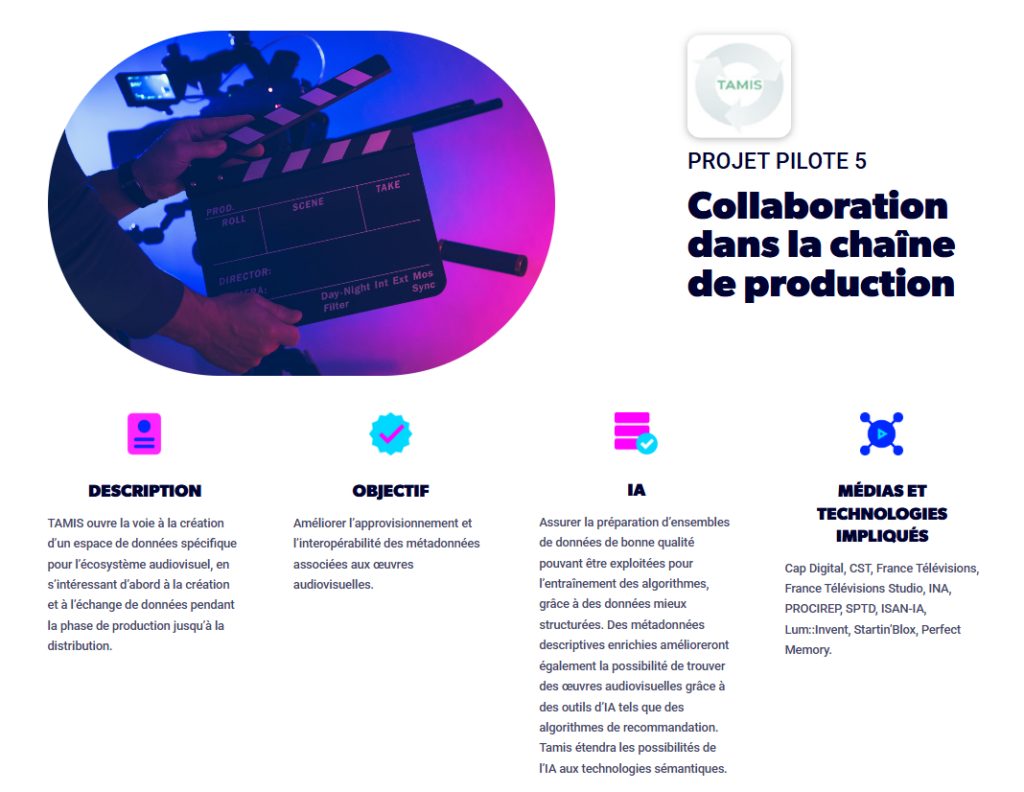
The TAMIS trial paves the way for the creation of a data space specifically for the audiovisual sector, initially focusing on the production phase through to the distribution of works.
The objective is to develop a decentralized framework for capturing, structuring, storing, and sharing metadata associated with audiovisual works among all stakeholders in the industry chain.
By leveraging open and interoperable technologies, TAMIS offers an approach where each stakeholder retains control of their data while being able to make it securely accessible to authorized partners.
Objective: to improve the interoperability of metadata
One of the major challenges in the audiovisual sector lies in data fragmentation: scattered metadata, heterogeneous formats, and a lack of synchronization between systems.
The TAMIS trial aims to:
- improve the quality and availability of metadata associated with works;
- facilitate its provision throughout the production chain;
- guarantee its interoperability between systems and organizations;
- create a “single source of truth” for a work’s data.
This approach streamlines industrial workflows, reduces errors, and strength the traceability of content.
Preparing data for artificial intelligence
Another strategic objective of the TAMIS trial concerns artificial intelligence. Reliable, structured, and standardized metadata is an essential prerequisite for training and operating AI algorithms.
TAMIS contributes to:
- preparing high-quality datasets for training AI models;
- enriching descriptive metadata to improve the discoverability of works through search engines and recommendation systems;
- extending AI capabilities through semantic technologies, enabling a more nuanced understanding of audiovisual content.
By structuring data from the production stage., TAMIS pose les bases d’un écosystème audiovisuel data-driven, capable de tirer pleinement parti des innovations en IA.
Towards a European framework for audiovisual metadata
As a TEMS trial, TAMIS represents a key step towards establishing a European audiovisual data space, interoperable with other sectoral spaces and aligned with the principles of digital sovereignty and data governance promoted by the European Union.
Ultimately, TAMIS aims to become a benchmark for the exchange of audiovisual metadata, fostering competitiveness, innovation, and the enhancement of creative works in the digital economy.