Created once.
Reused everywhere.
TAMIS is the flagship initiative aimed at providing the audiovisual production ecosystem with a framework to better manage, share and control metadata associated to an audiovisual work throughout its lifecycle : the Audiovisual Metadata Space
Watch the two-minute filmBuilt with the European audiovisual ecosystem




TAMIS is a pilot use case of TEMS, funded by the Digital Europe Programme under Grant Agreement No 101123423.
TAMIS in two minutes
The problem, the solution, TAMIS in TEMS and the use cases already under way.
Prefer reading? The same story continues just below.
 Introduction to TAMIS · 1:59 · YouTube (opens YouTube in a new tab)
All those involved in the creation of a work must exchange data. Current workflows are inefficient.
Audiovisual production is not just about producing and manufacturing a programme of images and sounds.
The added value of the descriptive and technical information linked to the different versions of audiovisual work is huge. When this metadata is reliable and easily accessible, it speeds up the production process, helps to market our European audiovisual heritage and helps tracking and remunerating rights holders when these audiovisual works are exploited.
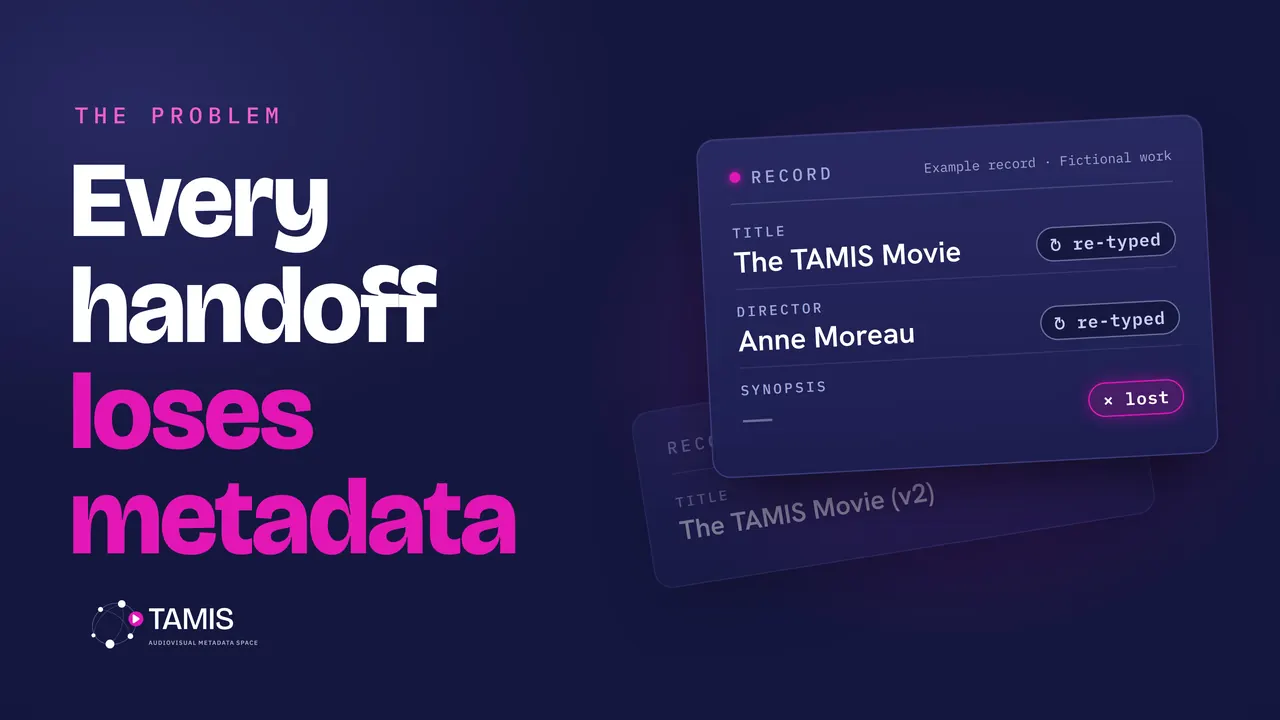
As of today, a lot of information and metadata (descriptive, technical or other) are lost during the production process, making it mandatory to rework many actions.
The metadata keeps growing. TAMIS facilitates its circulation.
For a single film, the significant volume of data exchanged - encompassing multiple creative and technical versions - involves an extensive network of collaborators. This complexity increases as the work progresses through its lifecycle.
No order here, and no complete list. These are moments in the life of a work, not steps in a sequence: several happen at once, some happen again, and others are not on this page at all.
Who contributes, and what they bring
- ISAN 0000-3BAB-9352-1A4F-8C7D-E90B One work, one unique identifier. It enables everything associated with it to be linked, regardless of who holds it.
-
Producer
From the first idea
Names the work, says what it is about and who is making it. Everything else hangs on this.
-
Identifier registry
Whenever identity has to be settled
Ties the work to a persistent identifier, so that everyone else can point at the same thing.
-
Post-production
Each time a version is made
Knows how the work was made, and how each version differs from the last.
-
Broadcaster
Around a broadcast
Knows what went out, when, in which version, and what was checked before it did.
-
Collective management
Whenever rights have to be paid
Knows who holds which rights, and what has to reach them.
-
Service providers
At any time
Subtitling, dubbing, audio description, indexing, quality control
Add what a specialist or a machine produces: translations, descriptions, indexes, accessibility.
-
Specialist media
Once the work is out
Reviews, features, interviews
Writes what has been said about the work, which is what makes it searchable by people who never worked on it.
-
Archive
Long after the rest
Holdings, restorations, context
Keeps the work findable and usable when everyone who made it has moved on.
-
And whoever comes next
Any participant (opens in a new tab) Participant An organisation admitted to the data space, identified under its rules and able to exchange within it. with information about a work is welcome here. TAMIS provides them with the tools they need to link it to the correct identifier.
A value that has been corrected in one place may be propagated to other users. Each correction indicates who made it and when, so that everyone can assess its reliability.
The metadata shown here are examples. They are not an exhaustive list of the metadata that can be described, found and exchanged through TAMIS.
A highly adaptable framework, capable of serving an infinite variety of specific use cases.
TAMIS aims to facilitate collaboration within trusted user groups. To this end, TAMIS is developing a range of services and business applications designed, on the one hand, to ensure the interoperability of data and systems and, on the other, to make it easier for smaller organisations to access the digital ecosystem of audiovisual production.
For example, using the ISAN (opens in a new tab) ISAN International Standard Audiovisual Number: the ISO identifier of an audiovisual work, which stays the same wherever the work travels. number enables metadata from different sources to be reconciled whilst eliminating the risk of errors. There is no need to copy everything into a single database; only the metadata you are looking for is displayed.
One work identifier
ISAN 0000-3BAB-9352-1A4F-8C7D-E90B
No central store
- Producer keeps titles, synopsis
- Post-production keeps versions, subtitles
- Identifier registry keeps reference record
- Archive keeps holdings, restorations
- Collective management keeps rights, shares
- Broadcaster keeps schedules, logs
Each of these organisations keeps what it knows about the work, on its own systems. The identifier is what lets a search reach all of them at once, without any of it being copied to a central store.
The metadata shown here are examples. They are not an exhaustive list of the metadata that can be described, found and exchanged through TAMIS.
A data space natively integrated into TEMS.
TAMIS is built as a data space (opens in a new tab) Data space A decentralised infrastructure enabling trustworthy data exchanges based on commonly agreed rules. : a governance authority verifies the identity of participants and enables trustworthy collaborations in a decentralised environment.
Trusted participants
The governing body maintains a register of participants and verifies each participant’s credentials. The certificate it issues enables everyone to know who they are dealing with. The verification process is described in the rulebook.
Your data stays yours
Nothing is copied into a central store. Each participant stores their data locally and decides who can access it, under what conditions, for what purpose and for how long.
Publish and discover
TAMIS acts as a dating site : it provides participants with the tools they need to describe their offers, whilst applying the defined rules – particularly regarding pricing where necessary – and makes these offers available to other participants who meet the visibility criteria set by the provider. Furthermore, TAMIS manages the search engine, which draws on a federated catalogue (opens in a new tab) Federated catalogue The mechanism that makes the offerings of every participant discoverable together, without centralising any data. bringing together participants’ offerings, thereby enabling users to discover datasets or services.
Interoperable by design
Using standards, sharing vocabularies, maintaining librairies and providing tools for mapping your own data formats into a public common ontology leads to an interoperable ecosystem for services and data exchanges. That is what makes an exchange possible between systems that were never designed together, and it is also what speeds up access to services: a service plugged in once is reachable by every participant.
What the data space is already used for
TAMIS began by establishing the trust framework and draws on three main use cases to demonstrate the value of the data space. As part of its future developments, TAMIS will also host offerings centred on business applications, data processing services and AI-based services for audiovisual production, making them accessible to all participants. New use cases will be added over time.
See what you can reachThe principles TAMIS is being built on
TAMIS is a trial of TEMS, the Trusted European Media Data Space, and it is being built on the principles TEMS set out. Its own legal entity does not exist yet: what follows is what we are working towards, and what we intend to be held to.
Not for profit
TAMIS has a cost: the shared infrastructure, keeping it running, making it better. That cost is covered by the participants. The principle it is being built on is that there are no shareholders to pay: what is collected serves the data space and nothing else. Participants stay free to exchange data and services commercially if they wish.
Sovereignty
You keep your data, and you keep the say: who gets access, on what terms, for what purpose and for how long. This is the principle the whole design is built on, and it is why nothing is copied into a central store unless you need it.
TAMIS holds neither your media files nor your metadata, and sharing is bilateral: you decide who receives what, one counterpart at a time.
Trust
TAMIS will guarantee the identity of participants by drawing on relevant trust anchors and issuing corresponding verifiable identifiers. The list of Trust anchors will be publicly available.
Each participant will be able to automatically check who is knocking at the door before signing a contract and will know how it has been verified.
Openness
Low barriers to entry, technical and financial alike, whatever the size of the organisation, and tools designed so that the smallest structures can take part. The rules that go with joining are still being agreed, and they will be published.
TAMIS will provide SAAS solutions to connect to the data space.
Interoperability
Open standards and open source components, so that it works between systems that were never designed together. It is also what is meant to keep any participant from ending up locked in with a single supplier.
Transparency
TAMIS is not a black box. In line with the value of ‘trust’, Tamis will ensure transparency regarding its governance structure, technical guidelines, conditions of participation and the rules to be followed.
Rules are clearly defined and will be publicly available. Procedure to update rules will also be clearly defined.
A pilot use case of the Trusted European Media Data Space
TEMS unites over 40 organisations across Europe, funded by the Digital Europe Programme of the European Union, to build a common European data space for media. TAMIS brings that sovereign infrastructure, trusted governance and collective standard to how audiovisual metadata moves across Europe, owned by the ecosystem rather than a platform.
Read about TEMS & the consortium → Visit the TEMS website (opens in a new tab)
Latest from the data space

TAMIS to demo live at IBC 2026 on the EBU stand
TAMIS will be shown live at IBC 2026, on the EBU stand, with a walkthrough of the full journey of a record from creation...

TAMIS and TEMS at the 8th Hub France Gaia-X plenary
The eighth plenary of the Hub France Gaia-X was held on Thursday 9 April 2026 at the French Ministry for the Economy, Fi...

Unlocking the potential of Europe’s audiovisual metadata
TEMS has published a piece on a problem the whole sector recognises: metadata that is inconsistent, incomplete or hard t...